

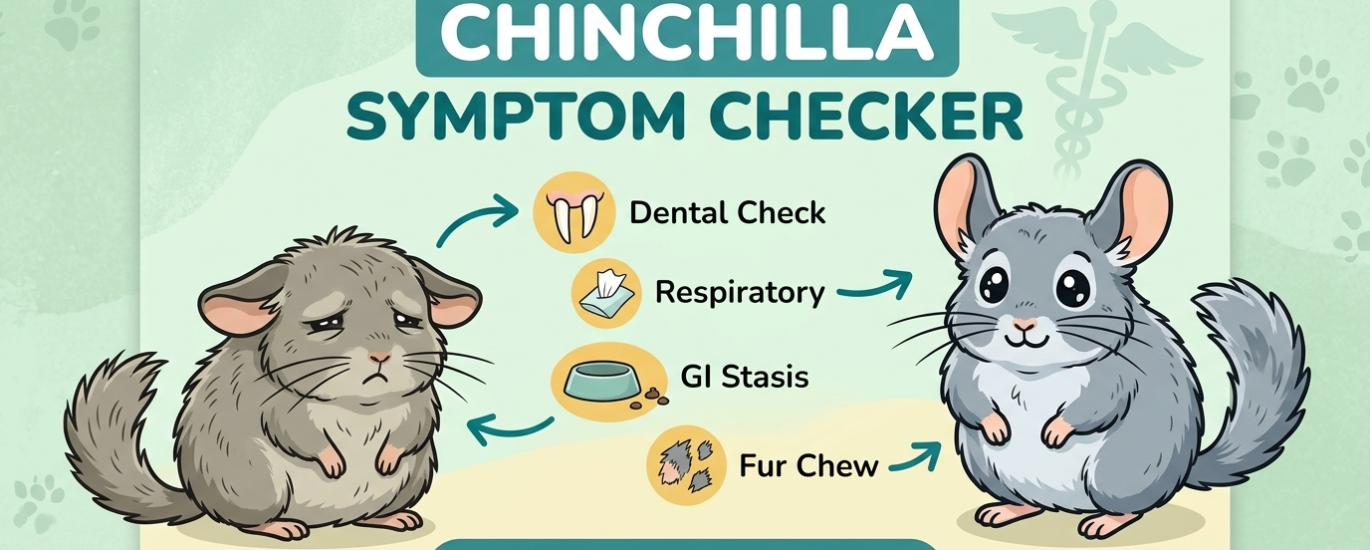
Is My Chinchilla Sick?
Answer a few questions to get triage guidance. Takes under 60 seconds.
How is your chinchilla acting right now?
Which mild symptoms have you noticed? (pick the most prominent)
How long have the abnormal droppings been going on?
Any additional signs with reduced appetite?
About the fur issue:
What are the main symptoms you can see?
How severe is the breathing difficulty?
Describe the GI symptoms:
How severe are the dental signs?
What other symptom is most prominent?
Is your chinchilla experiencing any of these right now?
Monitor at Home
Keep a close eye for the next 12–24 hours
Based on the symptoms described, your chinchilla does not appear to require emergency care right now — but chinchillas are prey animals that hide illness well. Stay vigilant.
What to do right now:
- Ensure unlimited fresh timothy hay is available — this is the #1 priority for gut health and teeth.
- Check that room temperature is 60–70°F (15–21°C) with ~40% humidity. Remove from heat immediately if above 75°F (24°C).
- Weigh your chinchilla daily. Any weight loss over 24 hours warrants a vet call.
- Count droppings morning and night — fewer or softer droppings mean things are changing.
- If the symptom was a clean fur slip, reduce stressors and avoid handling until fur regrows (6–8 weeks).
- For mild fur-chewing, check for stress triggers: boredom, overcrowding, or diet issues.
Upgrade to "Call your vet" if: symptoms persist beyond 12–24 hours, your chin stops eating, stops producing droppings, or you notice any deterioration.
💰 Estimated Vet Costs in Your Country
📢 Help other chinchilla owners — share this tool:
Call Your Exotic Vet Today
Schedule an appointment within the next few hours
Your chinchilla's symptoms suggest a condition that needs professional assessment today. Don't wait — chinchillas deteriorate quickly once symptoms become visible.
While you arrange your vet visit:
- Keep your chin warm and quiet — minimize handling and stress.
- Do NOT give any antibiotics unless a vet has prescribed them. Penicillin and ampicillin are toxic to chinchillas.
- If not eating: offer Critical Care (Oxbow) via syringe only if you have it and your chin cooperates. Do not force feed.
- For dental drooling: keep chin area dry, weigh daily, contact vet immediately for imaging referral.
- For eye/nasal discharge with lethargy: possible respiratory infection — isolate from other chinchillas.
- For suspected ringworm (circular patches): handle with gloves — it can transfer to humans.
- Bring a fresh fecal sample (in a sealed bag) to your appointment.
Make sure your vet is exotic-specialist trained. Ask: "How many chinchillas do you see per month? Do you have chinchilla dental X-ray capability?"
💰 Estimated Vet Costs in Your Country
📢 Help other chinchilla owners — share this tool:
Emergency — Go to a Vet NOW
Do not wait. Every minute counts.
Your chinchilla's symptoms indicate a life-threatening emergency. Contact an exotic emergency vet immediately. If you cannot reach one, go to the nearest emergency animal hospital.
While travelling to the vet:
- Do not feed or give any medication without vet guidance.
- Place your chin in a secure, well-ventilated carrier lined with soft fleece.
- Heatstroke: Dampen fur gently with COOL (not ice-cold) water only if temp is clearly above 27°C/80°F. Fan gently. Go immediately.
- Seizures: Keep the environment dark and quiet. Do not restrain. Cover gently to reduce sensory input.
- Bloat/GI tympany: Keep moving (gentle motion can help gas pass) but get to a vet — this can be fatal within hours.
- Bite wounds / bleeding: Apply gentle pressure with clean gauze. Do not remove the gauze; add more on top if needed.
- Collapsed: Keep warm, handle minimally, get there fast.
Call your exotic vet emergency line NOW before driving so they can prepare.
💰 Estimated Vet Costs in Your Country
📢 Help other chinchilla owners — share this tool:
Chinchilla Symptom Checker: Smart Triage for Your Pet
Is your chinchilla acting differently? Use this veterinary-informed decision tree to assess symptoms, determine urgency, and get clear next steps—from home care to emergency action.
Trusted data synthesized from: ChinchillaCaréHQ, VCA Animal Hospitals, Merck Veterinary Manual, and Chicago Exotic Animal Hospital.
How to Use This Tool
Step 1: Select your country below to see estimated veterinary costs in your local currency (for informational planning).
Step 2: Match your chinchilla’s symptoms to the categories.
Step 3: Follow the color-coded triage outcome: 🟢 Monitor at Home | 🟠 Call Your Vet Today | 🔴 Emergency – Go NOW
Select Your Currency for Cost Estimates:
🇺🇸 USD (US Dollar) 🇨🇦 CAD (Canadian Dollar) 🇦🇺 AUD (Australian Dollar) 🇪🇺 EUR (Euro – Germany, France, Italy, Netherlands) 🇵🇱 PLN (Polish Zloty) 🇨🇿 CZK (Czech Koruna) 🇯🇵 JPY (Japanese Yen) 🇷🇺 RUB (Russian Ruble)
Estimated exam starting costs: USD $75 | CAD $100 | AUD $120 | EUR €70 | PLN 300zł | CZK 1,800Kč | JPY ¥9,000 | RUB 2,500₽
Symptom Decision Tree
Step 1: Severity Screening
🔴 EMERGENCY FAST-TRACK (Go NOW)
If ANY of these are present, skip to Emergency Protocol.
- Seizures or loss of balance
- Open-mouth breathing or gasping
- Collapse, unable to stand
- Visible bleeding or suspected internal injury
- Unconsciousness
- Pale/white/bluish gums
- Temperature above 75°F (24°C) + weakness (heatstroke)
🟠 CLEARLY UNWELL (Call Vet Today)
- Not eating for >12 hours
- No droppings for 8+ hours
- Bloated/firm abdomen
- Labored breathing (not open-mouth)
- Drooling/wet chin (dental sign)
- Lethargy, hunched posture
🟢 MILD SIGNS (Monitor at Home)
- Slightly soft droppings, still eating some hay
- Reduced appetite but still nibbling
- Fur slip (bald patch, no inflammation)
- Occasional scratching at ears
- White teeth in adult (schedule non-urgent vet)
Detailed Symptom Checker (4-Level Depth)
🟢 Level 1: Mild Signs – Monitor at Home
| Symptom | Possible Cause | Owner Action |
|---|---|---|
| Soft but formed droppings | Dietary indiscretion, mild stress | Remove treats/veg, unlimited hay only |
| Reduced appetite (still eating hay) | Minor dental issue, mild GI slowdown | Offer hay only, monitor 12h |
| Fur slip (bald patch, no redness) | Startle response, rough handling | No treatment needed; improve handling |
| Occasional ear scratching | Possible early mites | Inspect ears; clean gently if needed |
| White teeth (adult, otherwise healthy) | Calcium deficiency | Schedule non-urgent vet for diet review |
🟢 MONITOR AT HOME – 6 Action Points
- Remove all treats, fresh vegetables, and pellets – offer only unlimited timothy/orchard hay.
- Ensure fresh, cool water in a clean bottle.
- Maintain ambient temp 60-70°F – no heat stress.
- Observe for 12-24 hours – monitor droppings, appetite, activity.
- Provide quiet, low-stress environment – limit handling.
- If no improvement in 24 hours, or any worsening → escalate to 🟠 Call Your Vet.
🟠 Level 2: Clearly Unwell – Call Your Vet Today
| Symptom | Possible Cause | Owner Action Before Vet Visit |
|---|---|---|
| No droppings for 8+ hours | Early GI stasis | Offer hay, check water, reduce stress |
| Not eating for 12+ hours | Dental pain, GI stasis, infection | Syringe feed Critical Care if experienced |
| Bloated/firm abdomen (mild) | Early bloat or gas | No tummy massage; call vet |
| Labored breathing (not open-mouth) | Respiratory infection | Keep cool, quiet, transport carefully |
| Drooling/wet chin | Dental malocclusion, spurs | Offer soft hay; vet for dental exam |
| Lethargy, hunched posture | Systemic illness, pain | Keep warm (not hot), minimize stress |
| Circular bald patches (face/ears) | Ringworm (zoonotic) | Wear gloves, isolate, call vet |
| Red/swollen foot pads | Bumblefoot (early) | Remove wire flooring, provide soft surface |
| Eye discharge (one eye, clear) | Dental root issue or irritant | Vet check – may need skull X-ray |
| Dark waxy ear buildup + head shaking | Ear mites | Vet for antiparasitic drops |
| Vaginal discharge (female) | Pyometra (uterine infection) – urgent | Call vet immediately – may be emergency |
🟠 CALL YOUR VET TODAY – Preparation & Care Steps
- Call your exotic vet immediately – describe symptoms, age, duration.
- Prepare a list: When did symptoms start? Last ate? Last droppings? Any recent changes?
- Keep chinchilla calm – reduce noise, handling, cage mates.
- Maintain hay and water – offer but don’t force.
- If not eating for 12+ hours and you have experience, offer syringe-fed Critical Care (every 4-6 hours).
- Note any deterioration – if condition worsens before appointment, escalate to 🔴 Emergency.
🔴 Level 3: Emergency – Go NOW
| Symptom | Likely Cause | In-Transit First Aid |
|---|---|---|
| Seizures (stiffening, twitching, paddling) | Hypocalcemia, listeriosis, toxin, epilepsy | Do NOT restrain – clear area. Keep dark, quiet. Time seizure. Transport immediately. |
| Open-mouth breathing / gasping | Severe pneumonia, heart failure, heatstroke extreme | Keep cool (65°F). Handle minimally. Emergency vet NOW. |
| Collapse / unable to stand | Shock, internal bleeding, severe dehydration | Wrap gently in soft cloth. Keep warm. Go immediately. |
| Bleeding (visible or suspected internal) | Trauma, bite wound, post-surgical complication | Apply gentle pressure with gauze (external). Keep calm. |
| Unconsciousness | Severe shock, heatstroke, toxin | Keep warm, head slightly lower than body. Transport NOW. |
| Pale/white/bluish gums | Shock, severe anemia, heart failure | Life-threatening – emergency vet en route. |
| Distended, firm, drum-like abdomen + weakness | Severe bloat, torsion | Do NOT feed or syringe. Go immediately. |
| Temperature exposure >80°F (27°C) + collapse | Heatstroke | Cool immediately (damp towel, not ice). Offer cool water if conscious. Transport. |
🔴 EMERGENCY – GO NOW: In-Transit First Aid by Condition
For Seizures:
- Do not restrain. Move nearby objects away.
- Time the seizure (tell vet).
- After seizure ends, transport in dark, quiet carrier.
For Heatstroke:
- Wrap in cool (not ice-cold) damp towel – focus on head/neck.
- If conscious, offer sips of cool water.
- Do not submerge unconscious animal (risk of aspiration).
For Bleeding:
- External: Apply gentle pressure with sterile gauze or clean cloth.
- Internal (suspected after fall/fight): Keep warm, minimal handling, transport immediately.
For Bloat (firm distended abdomen):
- Do NOT syringe feed or give water by mouth.
- Do NOT massage abdomen.
- Go directly to emergency vet.
For Collapse/Unconsciousness:
- Keep chinchilla wrapped in soft cloth, maintain warmth (not hot).
- If unconscious, do not give food/water.
- Transport immediately, call ahead to emergency vet.
After the Triage: What to Expect at the Vet
| Triage Outcome | Typical Vet Actions | Estimated Cost Range (USD) |
|---|---|---|
| 🟢 Monitor at Home | May not need visit; if seen: exam + fecal: $75-150 | $75-150 |
| 🟠 Call Your Vet Today | Exam, diagnostics (X-rays, bloodwork, dental exam), meds: $150-500 | $150-500 |
| 🔴 Emergency – Go NOW | Emergency exam, stabilization, critical care, hospitalization: $500-2,000+ | $500-2,000+ |
Note: Actual costs vary by region, clinic, and condition severity. Use currency selector above for local estimates.
Why This Symptom Checker Is Different
✅ Veterinarian-informed – Built from exotic animal hospital protocols (not AI guesswork)
✅ Four-level depth – Goes beyond “yes/no” to capture nuance
✅ Actionable outcomes – Every path includes specific owner steps
✅ Emergency first aid – Condition-specific in-transit care instructions
✅ Financial planning – Country-specific cost estimates
Frequently Asked Questions
Q: My chinchilla hasn’t eaten in 8 hours but is still active. What do I do?
A: This is 🟠 Call Your Vet Today. Loss of appetite for 12+ hours is urgent, but 8 hours with normal activity warrants a call to schedule same-day or next-day exam. Offer hay only, no treats.
Q: Can I use this tool instead of calling a vet?
A: No. This tool helps you triage and prepare, but it is not a substitute for professional veterinary advice. Always consult an exotic vet for diagnosis and treatment.
Q: What if my chinchilla has multiple symptoms from different levels?
A: Always follow the highest urgency level present. Example: soft droppings (🟢) + no appetite for 14 hours (🟠) = follow 🟠 Call Your Vet Today.
Q: How do I find an exotic vet near me?
A: Search for “exotic animal veterinarian” or “chinchilla vet” in your area. The Association of Exotic Mammal Veterinarians (AEMV) offers a find-a-vet tool. Ask clinics: “Do you treat chinchillas? Do you have after-hours emergency coverage?”
Emergency Quick Reference Card
🟢 Monitor at Home: Soft droppings, mild reduced appetite, fur slip, occasional ear scratching, white teeth (adult).
Action: Remove treats, unlimited hay, observe 24h.🟠 Call Your Vet Today: No droppings 8h+, not eating 12h+, mild bloat, labored breathing, drooling, lethargy, ringworm, bumblefoot, eye discharge, ear mites.
Action: Call immediately, keep calm, prepare history, offer hay.🔴 Emergency – Go NOW: Seizures, open-mouth breathing, collapse, bleeding, unconsciousness, pale gums, severe bloat, heatstroke.
Action: Transport immediately. Apply condition-specific first aid en route.
CHINCHILLA HEALTH SYMPTOMS CENTER
The Definitive Triage & Management Matrix
VITAL BASELINE PARAMETERS
| Parameter | Normal Range |
|---|---|
| Temp | 97–100°F (36.1–37.8°C) |
| Heart Rate | 100–150 bpm |
| Weight (Adult) | 400–600g |
| Lifespan | 10–20 years |
| Environment | 60–70°F, ~40% humidity |
1. DENTAL & METABOLIC CRISIS
| Disease | ⚠️ Key Symptoms | 🏥 Management Protocol |
|---|---|---|
| Malocclusion (Most common) | • Drooling / wet chin (“slobbers”) • Dropping food, eating slowly • White teeth in adults | • Unlimited grass hay (timothy, orchard) • Vet: Skull X-rays/CT, molar trim under anesthesia • Pain mgmt (Metacam), syringe feeding |
| Calcium Deficiency | • Pale/white teeth (adults) • Poor bone density, weakness | • Dietary correction (quality hay/pellets) • Vet-guided calcium supplementation |
2. GASTROINTESTINAL EMERGENCIES
| Disease | ⚠️ Key Symptoms | 🏥 Management Protocol |
|---|---|---|
| GI Stasis (Emergency) | • Reduced/absent droppings (first sign) • Hunched posture, lethargy • Tooth grinding | • Immediate vet care • Fluids (SC/IV), motility drugs (metoclopramide) • Syringe feeding (Critical Care) |
| Bloat (Tympany) (Life-threatening) | • Distended, firm abdomen • Lying on side, difficulty breathing | • Emergency decompression (stomach tube) • Pain mgmt, motility drugs • Poor prognosis if torsion occurs |
| Diarrhea | • Soft, sticky droppings • Staining around rectum | • Remove treats/veg, unlimited hay • Vet: Identify cause (bacteria/parasite) • Probiotics (acidophilus) |
| Constipation | • Small, dry, hard droppings • Straining, reduced appetite | • Increase hay, water, exercise • Vet if >12-24 hrs (risk of stasis) |
3. ENVIRONMENTAL & RESPIRATORY THREATS
| Disease | ⚠️ Key Symptoms | 🏥 Management Protocol |
|---|---|---|
| Heatstroke (Above 75°F dangerous) | • Panting, flat on floor • Red ears, weakness, seizures | • Cool immediately (damp towel, not ice) • Emergency vet en route • Prevent: AC, frozen water bottles |
| Respiratory Infection | • Runny/crusty nose, sneezing • Labored breathing | • Vet: X-rays, culture & sensitivity • Safe antibiotics (vet-directed) • Nebulization for severe cases |
4. DERMATOLOGICAL & PARASITIC CONDITIONS
| Disease | ⚠️ Key Symptoms | 🏥 Management Protocol |
|---|---|---|
| Ringworm (Zoonotic) | • Circular, scaly bald patches (face/ears) • Red, irritated skin | • Topical antifungal (miconazole) • Disinfect cage (bleach solution) • Wear gloves (transmissible to humans) |
| Fur Slip | • Sudden bald patch, clean edges • No inflammation | • No treatment needed (defense mechanism) • Improve handling technique |
| Fur Chewing | • Shorter fur patches on flanks/tail | • Enrichment: 1-2hr free-roam, wheel (15-18″), chews • Reduce stress, assess cagemate compatibility |
| Ear Mites | • Scratching ears, head shaking • Dark, waxy/crusty buildup | • Vet-prescribed antiparasitic ear drops • Gentle cleaning (do not probe deeply) |
| Internal Parasites | • Diarrhea, weight loss • Poor coat condition | • Fecal test to ID (Giardia, Coccidia, etc.) • Antiparasitic drugs (metronidazole, fenbendazole) |
5. MUSCULOSKELETAL & REPRODUCTIVE ISSUES
| Disease | ⚠️ Key Symptoms | 🏥 Management Protocol |
|---|---|---|
| Bumblefoot | • Red/swollen foot pads, sores • Limping | • Remove wire flooring → solid surfaces • Vet: wound cleaning, antibiotics • Maintain healthy weight |
| Hair Ring (Males) | • Excessive genital grooming • Penis unable to retract | • Monthly checks – extend penis • Gentle manual removal (KY jelly) • Vet if swollen or discolored |
| Pyometra (Females) | • Vaginal discharge, swollen abdomen • Lethargy, fever | • Emergency ovariohysterectomy • Prevent: Spay non-breeding females |
6. SYSTEMIC & NEUROLOGICAL DANGER SIGNS
| Disease | ⚠️ Key Symptoms | 🏥 Management Protocol |
|---|---|---|
| Seizures | • Stiffening, twitching, staggering | • Do not restrain – clear area • Emergency vet (find underlying cause: Ca/thiamine deficiency, toxin) |
| Heart Disease | • Lethargy, labored breathing • Bluish gums | • Vet: Echocardiogram, chest X-rays • Meds: diuretics, ACE inhibitors |
| Listeriosis | • Constipation, appetite loss • Later: head tilt, circling, seizures | • Immediate vet (injectable antibiotics) • Prevent: store hay from mice |
| Pseudomonas | • Green/yellow eye/ear discharge • Respiratory distress, diarrhea | • Culture & sensitivity critical (resistant) • Targeted antibiotics, disinfect environment |
| Shock | • Pale/white gums, cold extremities • Unresponsive | • Absolute emergency – keep warm en route to vet • IV fluids, oxygen |
7. SPECIALTY & SENSORY CONDITIONS
| Disease | ⚠️ Key Symptoms | 🏥 Management Protocol |
|---|---|---|
| Eye Problems | • Squinting, pawing at eye • Discharge, fur staining below eye | • Vet exam (rule out dental root cause) • Prescribed eye drops (never OTC human products) |
| Bite Wounds | • Visible wound or matted fur • Swelling, lethargy | • Clean with chlorhexidine • Cat/dog bites = emergency (Pasteurella risk) |
| Senior Health (7+ yrs) | • Reduced activity, weight loss • Dental decline, cataracts, arthritis | • Vet every 6 months • Lower platforms, softer bedding, gentle warmth |
🚨 RED FLAG ALERT: CRITICAL KNOWLEDGE
NEVER give oral penicillin or amoxicillin – toxic, fatal to chinchillas.
“Wait and see” is deadly – No eating for 12+ hours = vet immediately.
Cat/dog bites = Always emergency (Pasteurella risk).
🩺 OWNER’S FIRST AID KIT
| Item | Use |
|---|---|
| Critical Care (Oxbow) | Syringe feeding during anorexia |
| Chlorhexidine scrub | Wound cleaning |
| Styptic powder | Stop minor bleeding |
| Dilute bleach (1:10) | Cage disinfection (ringworm) |
| KY jelly | Hair ring removal |
📅 PREVENTIVE CARE SCHEDULE
| Frequency | Action |
|---|---|
| Daily | Monitor droppings, appetite, activity |
| Monthly | Male hair ring check, weight check |
| Annually | Wellness exam + fecal + dental X-rays |
| Senior (7+ yrs) | Vet every 6 months |
About This Resource
This Chinchilla Symptom Checker was developed by synthesizing clinical guidance from:
- ChinchillaCaréHQ – Comprehensive veterinary-reviewed health guide
- VCA Animal Hospitals – Exotic mammal protocols
- Merck Veterinary Manual – Standard reference for veterinary medicine
- Chicago Exotic Animal Hospital – Specialty exotic practice protocols
Last Updated: April 2026
Disclaimer: This tool is for informational and triage assistance only. It does not replace veterinary examination, diagnosis, or treatment. Always consult a qualified exotic animal veterinarian for any health concerns.
Related Resources: