

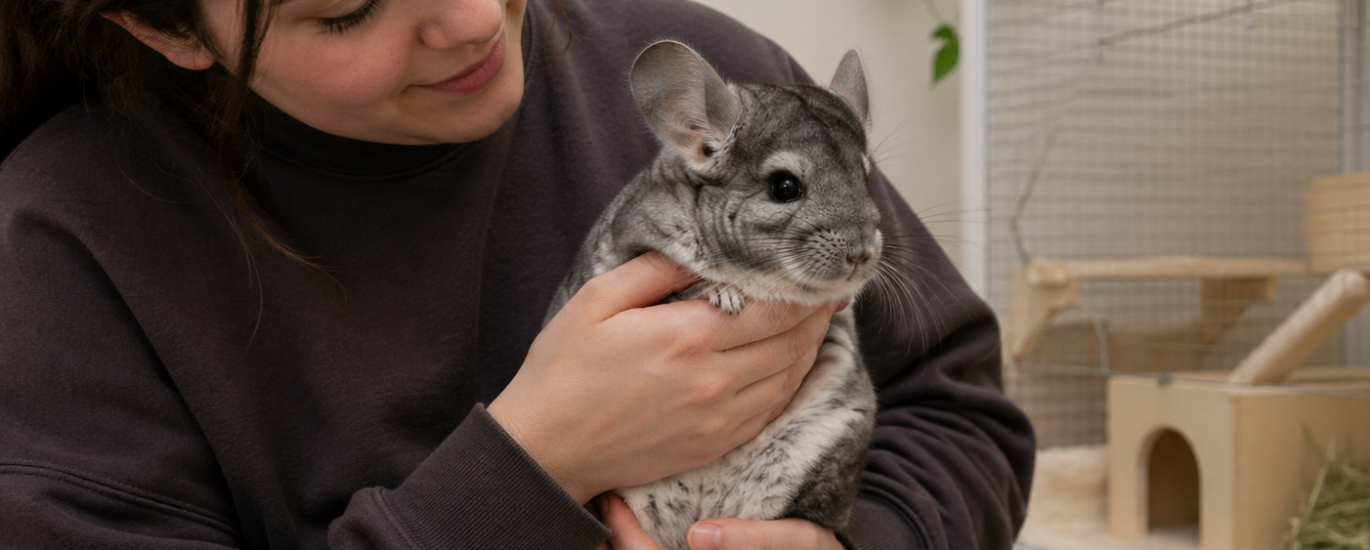
Chinchilla Handling, Grooming & Exercise: The Complete Owner’s Guide (2026)
Chinchillas are extraordinary animals — intelligent, affectionate, and endlessly entertaining. Yet many first-time owners are surprised to discover that winning a chinchilla’s trust requires patience, consistency, and a genuine understanding of how these animals think. At heart, chinchillas are prey animals with sharp survival instincts. Learning to work with those instincts — rather than against them — is the foundation of every successful chin-owner relationship.
This guide walks you through everything from your very first interaction to advanced training techniques and safe exercise setups, incorporating the latest best practices from exotic animal veterinarians and experienced breeders.
Understanding Your Chinchilla’s Nature
Before you reach into that cage, it helps to understand what’s happening inside your chinchilla’s mind. In the wild, chinchillas live in large social colonies on the rocky slopes of the Andes, always alert for predators. This heritage gives them extraordinary agility, lightning-fast reflexes, and an instinct to flee at the first sign of danger.
A chinchilla’s flight instinct is not a personality flaw — it’s survival intelligence. Your job as an owner is to become someone worth trusting, not to override that instinct by force.
This is why slow, deliberate movements and a calm, quiet voice are so important. Sudden movements, loud noises, or unfamiliar people can send even a well-socialized chin bolting for cover. The good news: chinchillas are genuinely social animals and, once trust is established, they actively seek out human interaction. They’re simply selective about it.
2025 Best Practice — Stress Signals to Watch
Modern exotic animal veterinarians now emphasize reading your chinchilla’s body language before every interaction. Signs of stress include flattened ears, teeth chattering (a warning bark), fur-slipping (releasing tufts of fur as a defense mechanism), and a rigid, freeze-and-bolt posture. If you see these signals, stop and give your chin space. Conversely, relaxed curiosity looks like upright ears, grooming behavior, and a willingness to approach your hand without prompting — all green lights for gentle interaction.
Taming Your Chinchilla: Building Trust From Day One
Whether you’ve brought home a baby chinchilla or an adult with minimal handling history, the taming process follows the same patient, incremental path. Rushing any stage sets you back significantly — respect the timeline your individual chin sets.
Phase 1 — Settling In (Days 1–7)
Give your new chinchilla a full week of low-interference time. Place the cage in a quiet room away from other pets, televisions, and foot traffic. Your only contact during this period should be the daily routines of feeding, watering, and refreshing the dust bath — all done slowly and with a soft, consistent voice. Doing these chores at the same time each evening (when chinchillas are naturally most active) builds a comforting routine.
Phase 2 — Hand Introduction (Week 2 Onward)
Once your chin no longer bolts when you open the cage door, it’s time for hand introduction. Place your hand calmly inside the cage, palm up, and simply let it sit there. Don’t reach for the chin. Let curiosity do the work. Most chinchillas will eventually inch forward to investigate — this is the breakthrough moment.
Phase 3 — Treat Training
Introduce a small treat — half a raisin works extremely well, as most chinchillas find them irresistible. Hold it at the very tips of your fingers first, then gradually move it further up your palm over subsequent sessions. The chin will need to step onto your hand to reach the treat, which creates positive, voluntary physical contact. Limit treats to two raisin halves per day to protect your chin’s sensitive digestive system.
Important — Treat Limits: Chinchillas have delicate digestive systems not designed for sugary foods. During taming and training, raisins are invaluable tools, but must be rationed to no more than two small pieces daily. Alternatives that work well include small pieces of dried rose hips, plain rolled oats, or species-appropriate commercial chin treats with no added sugar or artificial ingredients.
How to Safely Pick Up and Handle a Chinchilla
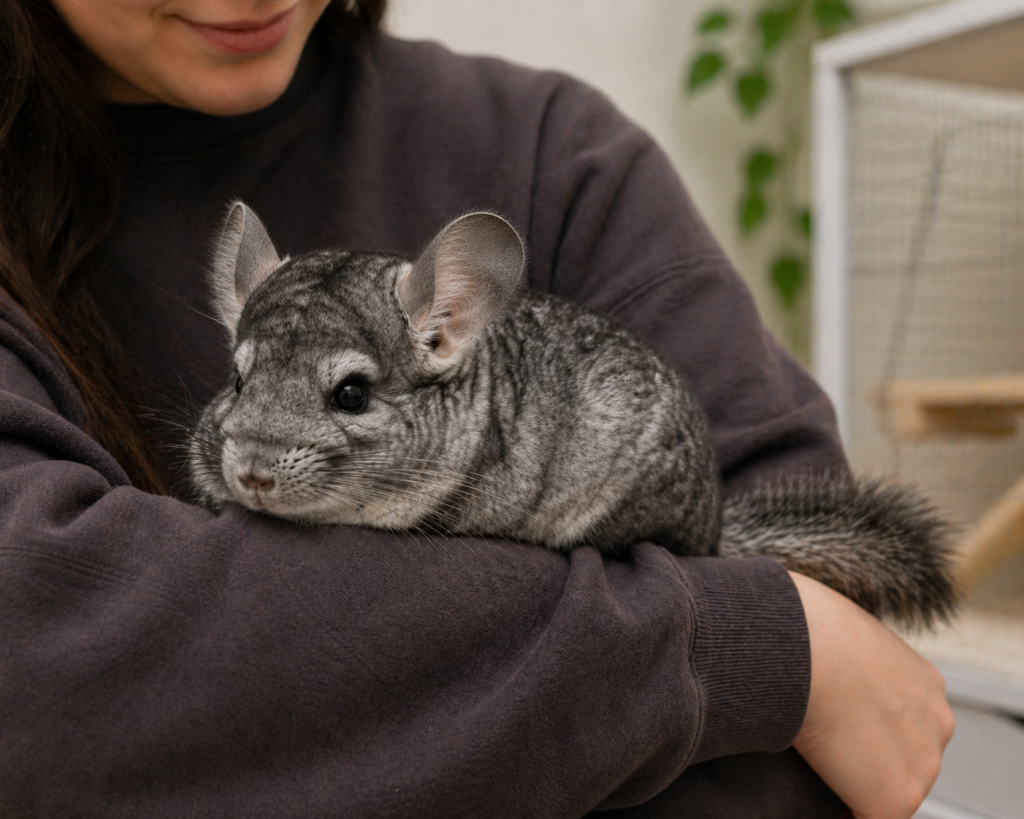
Chinchillas are not natural cuddlers in the way a guinea pig or rabbit might be. Many prefer sitting on a shoulder or lap — where they feel in control of the contact — over being firmly held. That said, proper handling technique keeps your chin safe regardless of their individual preferences.
The Correct Pick-Up Technique
- Speak first. Before reaching in, address your chin in a quiet, soothing voice for a few seconds. This simple habit dramatically reduces startled reactions.
- Scoop from below. Slide one hand under the chinchilla’s body, supporting the hind end — the heaviest part. Never grab from above, which mimics a predator strike.
- Secure gently with your second hand. Place your other hand lightly over the back and sides. The hold should feel like a secure cradle, not a cage — firm enough to prevent a fall, never tight enough to restrict.
- Hold against your chest when moving. If you need to carry your chin any distance, press them gently against your chest with both hands. This feels secure and keeps them from leaping.
- If they struggle, let go gracefully. If your chin begins to thrash, don’t fight them — set them down or return them to their cage immediately. A struggling chinchilla can injure itself or shed fur defensively. Wait a few minutes and try again calmly.
Never do these things: Do not lift a chinchilla by the ears under any circumstances — this is painful and can cause injury. Lifting by the tail is sometimes practiced by experienced breeders for brief, controlled restraint, but is not recommended for pet owners due to the injury risk in untrained hands. If you need to restrain your chin for a health check, grasp the base of the tail with one hand while gently pressing the body against a flat, safe surface with the other.
Catching a Loose Chinchilla
Chinchillas are extraordinarily fast — faster than most people expect. The most effective strategy is to corner them, which removes the escape options their flight instinct relies on. Once cornered, place both hands on either side and sweep them toward your chest. A clever alternative: shake their dust bath container near the floor. The irresistible allure of a dust bath will often draw a hiding chin out in minutes — when they enter the bathhouse, simply carry the whole thing back to the cage.
Grooming Your Chinchilla
Chinchillas are fastidiously clean animals with one uniquely specific grooming requirement: the dust bath. Unlike most small pets, chinchillas should never be bathed in water. Their incredibly dense fur — around 60 hairs per follicle compared to a single hair in humans — takes an extremely long time to dry, making them highly vulnerable to fungal skin infections and potentially fatal chilling if wet.
The Dust Bath: How, How Often, and What to Use
The dust bath is a chinchilla’s primary grooming mechanism. Rolling in fine volcanic dust strips excess moisture and oils from the coat, keeps the fur from matting, and appears to provide genuine psychological satisfaction — most chinchillas attack their dust bath with visible enthusiasm.
2025 Best Practice — Dust Bath Protocol
- Frequency: Two to three times per week is the current veterinary consensus for most environments. In humid climates (such as coastal or tropical regions), increase to four times weekly. In very dry climates, twice weekly is often sufficient to prevent coat over-drying.
- Duration: Allow 10–15 minutes per session. Longer sessions can over-dry the coat and irritate eyes. Watch for signs they’re done — they’ll typically stop rolling and start grooming with their paws instead.
- Product: Use only chinchilla-specific volcanic ash (often labeled “blue cloud” dust) or fine pumice dust. Never use play sand, regular sand, or cat litter substitutes — these particles are too large and can cause respiratory irritation. Avoid scented or deodorized products entirely.
- Container: Use an enclosed container large enough for your chin to roll freely — a chinchilla-specific bathhouse or a ceramic bowl with high sides. Fill with approximately 2 inches of dust.
Coat and Ear Care
Beyond dust bathing, chinchilla grooming needs are minimal. A fine-toothed chinchilla comb can be used to gently work through any minor tangles in long-coated or show chinchillas, though standard pets rarely need this. Inspect your chinchilla’s ears weekly — they should be clean, dry, and free of discharge. Any redness, odor, or dark debris warrants a veterinary visit to rule out ear mites or infection.
Nail Trimming
Chinchilla nails grow continuously and may need trimming every 8–12 weeks if your chin doesn’t naturally wear them down on rough surfaces. Use small, sharp pet nail scissors or a dedicated small-animal nail trimmer. Trim only the clear tip, avoiding the pink quick (blood vessel) visible inside the nail. If your chin is difficult to restrain for nail trims, most exotic vets offer this service at reasonable cost, or you can have a vet demonstrate the technique on your first visit.
Dental Awareness
Current veterinary guidelines increasingly emphasize dental monitoring as part of routine chinchilla care. Chinchillas have open-rooted teeth that grow continuously throughout their lives. Malocclusion (misaligned teeth) is one of the most common and serious health problems in the species. Signs to watch for include drooling, difficulty eating, weight loss, or a preference for soft foods. Annual dental checks by an exotic animal vet are recommended from age two onward.
Training Your Chinchilla
Chinchillas are more trainable than many people realize — they’re quick learners with good memories and a strong food motivation. They won’t sit and stay like a dog, but they can reliably learn a handful of useful and fun behaviors that make daily life with them significantly easier.
The Foundation: Trust Before Training
Training cannot begin until taming is complete. Your chinchilla must voluntarily approach you, take treats from your hand without hesitation, and tolerate gentle handling without panicking. Attempting to train a chin that still fears you will only produce anxiety and set back your relationship.
Coming When Called
Choose a short, distinctive phrase — “Chin, come!” or “Treat time!” — and use it consistently every single time you offer a treat during out-of-cage time. Say the phrase, then immediately produce the treat. After two to three weeks of daily repetition, most chinchillas make the association and will trot toward you when they hear it — treat or no treat. Keep the recall phrase distinct from anything you say in ordinary conversation.
Returning to the Cage on Command
This is one of the most practically useful behaviors to teach. Give a consistent cage command (“Home!” works well) each time you end free-run time, then carry your chin to the cage while offering a treat. Gradually, place the treat inside the cage rather than in your hand — your chin learns that the command predicts a treat waiting inside. Eventually the treat becomes intermittent, but the behavior remains.
Critical Rule — Never Punish After Recall: Never call your chinchilla and then do something unpleasant — such as medicating them, clipping their nails, or ending a play session they’re clearly enjoying. A recalled chinchilla that experiences something negative will rapidly learn to run the other direction when they hear their name. Keep every recall experience either neutral or positive.
Tricks: Spins and Flips
Many chinchillas can be taught to spin, jump, or perform small “dances” on cue. Hold a treat just above and slightly behind your chin’s head, moving it in a slow circle. Your chin will follow the treat with their nose and turn their body. Mark the moment they complete the motion with immediate treat delivery and verbal praise. With consistent daily practice, the hand gesture alone becomes the cue.
Litter Training (Partial)
Chinchillas tend to urinate in a preferred corner of their cage consistently. Once you identify this spot, place a ceramic crock filled with a small amount of soiled bedding there — this scent-marks the designated toilet area. Over time, swap the soiled bedding for unscented clay litter or organic paper-based litter (never clumping or scented cat litter). Most chins adapt well to this for urine. Fecal pellets, however, are distributed freely as a natural behavior and are not reliably trainable.
Exercise: Meeting Your Chinchilla’s Physical Needs
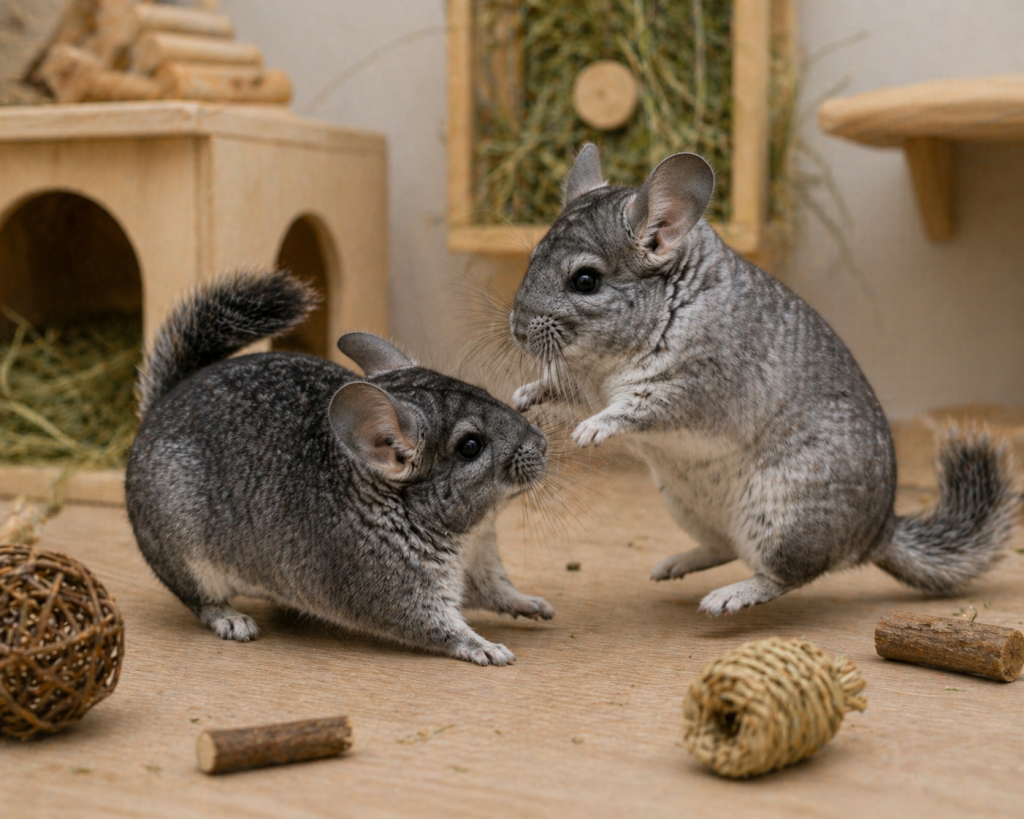
In the wild, chinchillas range across large territories every night — foraging, socializing, playing, and covering considerable distances. Domestic chinchillas confined to a cage are entirely dependent on their owners to provide meaningful physical activity. Insufficient exercise leads to obesity, muscle weakness, stereotypic behaviors (repetitive movements signaling boredom or stress), and shortened lifespan.
How Much Exercise Does a Chinchilla Need?
The minimum recommendation from most exotic mammal specialists is one to two hours of supervised free-run time daily, outside the cage, in a safe environment. Some veterinarians recommend up to four hours for optimal physical and psychological health — particularly for single chinchillas without a cage companion for enrichment.
2025 Best Practice — Enrichment-Based Exercise
Modern exotic animal enrichment science recommends thinking beyond simple “run time.” Provide a variety of textures, obstacles, and foraging opportunities during free-run sessions. Scatter small treats among wooden blocks or tunnels to encourage natural foraging behavior. Rotate toys weekly to maintain novelty. This approach engages both body and mind, reducing boredom-related behaviors more effectively than plain floor time alone.
Chinchilla-Proofing Your Exercise Space
Free-run time requires a dedicated, thoroughly chinchilla-proofed space. Chinchillas will chew almost anything they encounter — electrical cords are the most serious hazard, but furniture legs, baseboards, books, and houseplants are all targets. Most experienced owners designate a single room or use a chinchilla-safe playpen rather than attempting to proof an entire home.
Room options and considerations:
- Bathroom: Typically the safest choice — fewest cords and chewable hazards. Always check for hidden gaps behind fixtures. Keep the toilet lid closed, remove chemicals and personal care items from reach, and ensure the tub is completely dry.
- Bedroom: Workable if thoroughly prepared. Move all shoes, books, cords, and fabric items off the floor. Be aware that chinchillas are enthusiastic about mattress edges and anything hanging down from furniture.
- Living room: The most challenging — typically full of electrical cords, upholstered furniture (which chins will tunnel into), and houseplants. Use only with extensive preparation and constant supervision.
- Home office: Generally not recommended — dense concentration of cables and cords makes safe proofing very difficult.
Electrical Cord Safety: If a chinchilla chews through a plugged-in electrical cord, the result can be fatal electrocution and a serious fire hazard. Run all cords through plastic aquarium tubing split lengthwise — this is the single most effective cord-protection method available. Never rely on “keeping them away” from cords without physical barriers.
What to Provide During Free-Run Time
Enrich your chin’s exercise sessions with a variety of safe toys and surfaces. Good options include untreated wooden blocks for chewing, cardboard tubes and boxes, unpainted wicker structures, bird-safe hanging toys, PVC pipe tunnels, empty oatmeal containers, grass mats for burrowing, and cornstarch-based edible chew toys. Place the dust bath in the exercise space too — most chins will happily take a bath mid-session. If you have multiple compatible chinchillas, let them run together for maximum enrichment.
The Exercise Wheel
An exercise wheel is not a substitute for free-run time, but it’s a valuable supplement — especially for burning energy during the night hours when your chin is at peak activity.
2025 Best Practice — Choosing a Safe Wheel
- Size: Minimum 14–15 inches (35–38cm) in diameter. Smaller wheels force an unnatural spinal arch that can cause chronic back problems. Many exotic vets now recommend 16-inch wheels as the gold standard.
- Surface: Must be completely solid — no wire, mesh, or slatted surfaces. These trap feet and legs and cause degloving injuries. Look for solid plastic, metal, or a closely-spaced rod design (spacing under 2mm).
- Bearing quality: A smooth, quiet bearing reduces noise during night-time use and prevents stress-causing vibration.
- Placement: Leave the wheel in the cage permanently so your chin can use it on their own schedule. Inspect weekly for wear or loose components.
Movement Safety: A Frequently Overlooked Risk
One of the most tragic and preventable chinchilla accidents occurs not from chewing or escape, but from being stepped on. Chinchillas move with extraordinary speed — they can cross a room faster than most adults can react — and they have a tendency to dart toward feet. Always shuffle rather than lift your feet when a chinchilla is loose in a room. Make all family members and visitors aware of this rule before entering the exercise space.
Quick Reference: Core Principles
- Move slowly, speak softly, and always telegraph your movements before reaching into the cage.
- Never force interaction — let your chin set the pace of taming. Patience measured in weeks, not days, is normal.
- Provide a dust bath two to three times per week using genuine volcanic ash dust. Never use water to bathe a chinchilla.
- Offer a minimum of one hour of supervised free-run time daily in a fully chinchilla-proofed space.
- Install a solid-surface exercise wheel of at least 14 inches in diameter and leave it accessible at all times.
- Keep training sessions positive, short (5–10 minutes), and treat-limited (max two raisin pieces daily).
- Schedule annual vet checks with an exotic animal specialist, including dental assessment from age two.
- Always shuffle your feet when a chinchilla is loose in a room — never lift and step.
This article is for informational purposes only and does not constitute veterinary advice. Always consult a qualified exotic animal veterinarian for health concerns specific to your chinchilla.