

The Complete Chinchilla Cage Guide: Size, Setup, Accessories & Location (2026)
Whether you’re a first-time chinchilla owner or looking to upgrade your chin’s current home, choosing the right chinchilla cage is the single most important decision you’ll make for your pet’s health and happiness. This comprehensive guide covers everything you need to know — from minimum cage dimensions and safe materials, to accessories, bedding, location, and cleaning — backed by veterinary guidance and current research.
Why the Right Chinchilla Cage Matters
Chinchillas are highly active, intelligent small mammals native to the rocky Andes mountains of South America. In the wild, they leap between boulders, forage constantly, and cover significant ground. In captivity, the cage becomes their entire world — so getting it right is non-negotiable.
A cage that is too small, poorly ventilated, or made from the wrong materials can lead to serious welfare problems. Behavioural disorders such as fur-biting, aggression, and depression are closely linked to inadequate housing. According to VCA Animal Hospitals, chinchillas are very active, agile, and acrobatic animals that need ample room to move around. Beyond behaviour, insufficient movement can contribute to digestive problems, weight gain, and weakened joints.
Chinchillas kept indoors with their human family also live longer, bond more closely with their owners, and are protected from predators and extreme weather. Simply put: a great cage is the foundation of a great life for your chin.
Chinchilla Cage Size: What Do Experts Recommend?
Cage size is the most debated topic among chinchilla owners, and recommendations have evolved significantly over the years. The old guidance of “at least 2 cubic feet” is now widely considered far too conservative.
Current Minimum Size Guidelines
Most modern veterinary and chinchilla welfare sources now recommend considerably more space than older pet care manuals suggest:
- Absolute minimum for one chinchilla: 3 ft × 2 ft × 2 ft (approximately 91 cm × 61 cm × 61 cm)
- Better recommended size for one chinchilla: 3 ft × 3 ft × 3 ft or larger
- Recommended for a pair: 3 ft × 2 ft × 5 ft or 4 ft × 4 ft × 3 ft
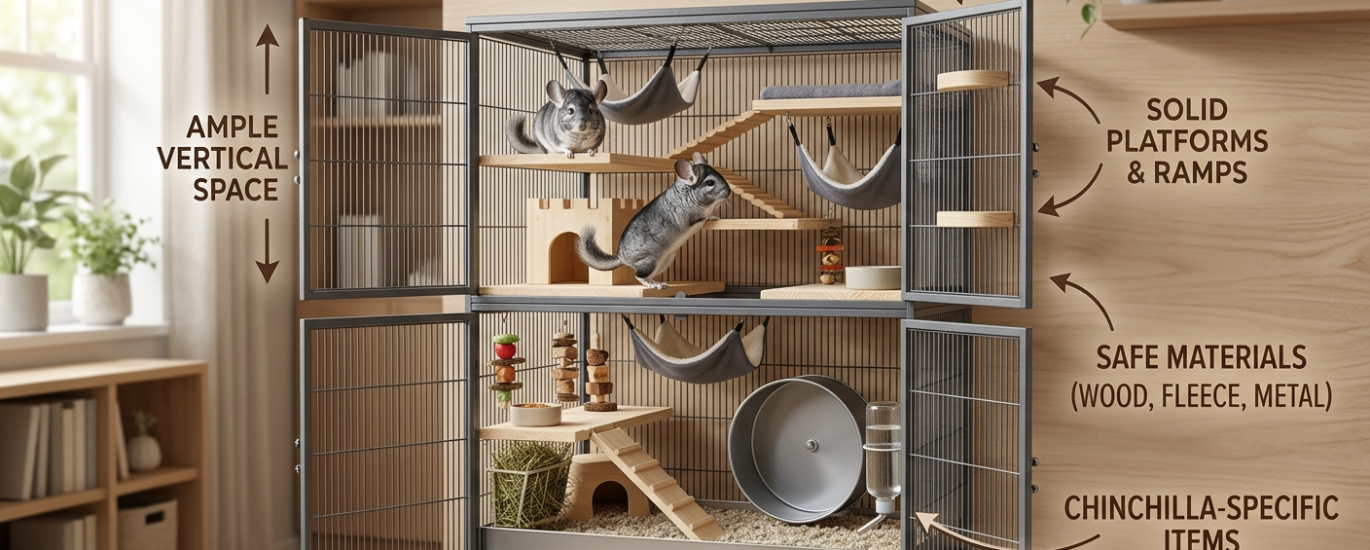
According to The Vet Desk, the absolute minimum should be at least 3 feet wide, 3 feet deep, and 3 to 4 feet tall — with multiple ramps, perches, and platforms. Because chinchillas can jump up to 6 feet high, a taller cage with safe multi-level platforms is always preferred.
Small Pet Select recommends a good size for a single chinchilla as 4 ft × 4 ft × 3 ft — noting that most cages sold in pet stores are “almost always way too small.”
A Note on Cage Height vs. Floor Space
Chinchillas love to climb and jump, so height matters — but floor space matters too. Think vertical and horizontal. Tall cages are excellent, provided you add enough wide shelves and platforms to break up the vertical space. Without adequate platforms, a very tall cage poses a fall risk. As Forever Feisty Chinchilla Rescue advises, make sure your chinchilla has several solid surfaces to rest on at different levels.
What Does the Science Say?
A fascinating 2024 study published in PMC/MDPI found that adult chinchillas actually preferred smaller, lower cages when given a free choice between sizes — a reflection of their wild instinct to shelter in narrow rocky crevices for protection from predators. However, researchers stressed that cage enrichment (toys, platforms, hideouts) is the key variable for wellbeing. The takeaway: a well-enriched mid-to-large cage beats both a barren giant cage and a tiny bare one.
Chinchilla Cage Materials: What’s Safe?
Wire Is Best
The best chinchilla cages are made from wire mesh. Aquariums and glass tanks are never appropriate — they have dangerously low airflow and can cause rapid overheating. Wooden cage frames are also problematic because chinchillas will chew through them quickly.
Wire spacing guidelines:
- Side panels: no more than 1 inch × 1.5 inches (some sources say 1 × 2 inches maximum)
- Cage bottom/floor: no more than ½ inch × ½ inch — larger gaps can trap feet and cause leg injuries
According to VCA Animal Hospitals, galvanized wire should be avoided as it contains zinc, which is toxic if ingested. Look for powder-coated or “galvanized after weld” (GAW) wire, which is far safer.
Solid Floor Sections Are Essential
If your cage has a wire floor, you must provide solid resting areas. Constant contact with wire mesh causes a painful condition called pododermatitis (commonly known as “bumblefoot” or “sore hocks”). A section of untreated wood, Plexiglass, hard plastic, or a fleece liner gives your chin’s feet vital relief.
Avoid These Materials
- Cedar wood — toxic to chinchillas’ respiratory systems
- Plastic-coated wire — chins will chew through the coating
- Galvanized wire — contains toxic zinc
- Rabbit, ferret, or guinea pig cages — wire spacing is usually too wide and dangerous
Essential Chinchilla Cage Accessories
A bare cage is not enough. Chinchillas are active, curious animals and need a fully equipped environment to thrive. Here’s what every chinchilla cage needs:
Exercise Wheel
An exercise wheel is one of the most important items in the cage. Choose one that is:
- At least 14–15 inches in diameter (15–18 inches is even better)
- Made from metal or very hard plastic — not mesh or wire, which can trap feet
- Solid-surface running area — a solid wheel protects legs and feet far better than a mesh one
Avoid small wheels designed for hamsters or other rodents; these force chinchillas to arch their backs unnaturally and can cause spinal injury.
Hide Box / Shelter
Chinchillas are prey animals with a strong instinct to seek cover. A hide box gives your chin a place to sleep during the day, retreat to when stressed, and feel genuinely secure. Options include:
- Wooden hideouts (untreated, kiln-dried pine)
- Cardboard boxes (tape-free and plastic-free)
- PVC or cardboard tubing (4–5 inches in diameter)
Your chin will chew on the hide box over time — that’s completely normal. Budget to replace it periodically.
Shelves and Platforms
Multiple levels within the cage are vital. Shelves give chinchillas space to jump, perch, and explore. They should be:
- Made from hard plastic or untreated pine
- Placed at staggered heights across from each other to encourage jumping
- Spaced so there is no dangerous fall distance between levels
Water Bottle
Fresh water is critical to chinchilla health. Always use a gravity-fed hanging water bottle mounted to the side of the cage. These prevent water from being soiled by bedding or waste, and are far more hygienic than open bowls. Clean the bottle daily with soap and water.
Food Bowl / Feeder
Choose a heavy ceramic crock (which is harder to tip) or a metal/hard plastic cup that attaches to the side bars. Avoid plastic bowls — chinchillas chew through them quickly. The feeding cup should be shallow enough for the chin to reach all the food at the bottom, and positioned low enough that the chin can access it comfortably.
Hay Rack
Hay is an essential, daily component of a chinchilla’s diet and should be available at all times. A hay rack keeps hay contained, clean, and accessible. Most are metal and hang on the side of the cage. They prevent hay from being scattered and soiled on the cage floor.
Chew Toys and Enrichment
Chinchillas have continuously growing teeth that must be worn down through chewing. Safe chew materials include:
- Kiln-dried pine sticks and blocks
- Apple wood sticks
- Willow or wicker (untreated)
- Cardboard tubes (toilet roll cores are a favourite)
- Commercially produced chinchilla/rabbit toys
Never use: cedar, plum, cherry, oleander, or redwood — these woods are toxic to chinchillas.
Small Pet Select recommends rotating and changing the cage setup monthly — moving shelves around, swapping in different hanging toys, and changing the hay rack location — to keep your chinchilla mentally engaged and prevent boredom.
Dust Bath House
Chinchillas don’t bathe in water — they maintain their uniquely dense, silky coats by rolling in volcanic dust. A dust bath should be offered at least 3 times per week for 10–15 minutes per session, then removed. Leaving the dust in the cage permanently over-dries the coat and irritates eyes.
A purpose-built commercial dust bath house (usually a translucent plastic container shaped like a small house) is ideal for keeping dust contained. Alternatively, a ceramic bowl, stainless steel bowl, or large glass jar can work. Make sure it’s big enough for your chin to roll and spin comfortably.
Use only chinchilla-specific volcanic dust powder, available from specialist pet retailers. Replace the dust approximately once a month. Do not use sand as a substitute without consulting your vet — some sand types have been identified as potential respiratory irritants.
Chinchilla Cage Bedding
The best bedding sits inside the hide box and lines the base of the cage. Current recommendations from vets and chinchilla welfare experts favour:
- Kiln-dried pine shavings — widely used and considered safe when properly dried (available from specialist small animal retailers)
- Recycled paper bedding — soft, absorbent, and widely available at pet stores
- Fleece liners — popular with many owners, easy to wash and reuse, gentle on feet
Avoid cedar shavings at all times — the aromatic oils are hazardous to a chinchilla’s respiratory health. According to VCA Animal Hospitals, wood shavings can also cause gastrointestinal blockages if ingested in quantity, so paper-based or fleece bedding is increasingly the preferred choice.
Spot-clean the cage daily and do a full bedding replacement at least once a week.
Cage Location: Where to Put Your Chinchilla’s Cage
Where you place the cage is just as important as the cage itself. Keep these factors in mind:
Temperature
Chinchillas have extremely dense coats evolved for cold, high-altitude conditions. They are highly susceptible to heatstroke. The cage must be kept where the temperature never exceeds 80°F (26.7°C). Keep it away from:
- Direct sunlight
- Radiators, stoves, and furnaces
- Any direct heat source
A cool, stable room temperature is ideal. Avoid drafts too — consistency matters.
Noise and Foot Traffic
Chinchillas are nocturnal and naturally nervous animals. Too much loud noise causes chronic stress. Place the cage:
- In a room with moderate human activity — a den, home office, or dining room works well
- Away from the bedroom — your chin will be active and noisy at night
- Against a wall or in a corner (not freestanding in the middle of a room) — this gives your chin a greater sense of security
Safety from Chewing
Chinchillas can reach through cage bars with surprising dexterity. Place the cage well away from curtains, electrical wires, houseplants, and any object you wouldn’t want chewed. Anything within reach of a curious paw is fair game.
Cage Cleaning: Keeping It Hygienic
A clean cage is essential for your chinchilla’s long-term health. A dirty cage breeds bacteria rapidly and can make your chin seriously ill.
Daily tasks:
- Remove soiled bedding and replace with fresh
- Pick up leftover food and hay
- Clean the food bowl and water bottle with soap and water
Weekly tasks:
- Empty and scrub the entire cage with a mild bleach solution (a bucket of warm water with a small splash of bleach)
- Allow the cage to dry completely — ideally in the sun — before returning your chin
- Clean all toys and accessories
While cleaning, confine your chinchilla safely in a travel carrier or a chin-proofed room.
Travel Carriers: A Useful Extra
A small, hard plastic travel carrier is worth having on hand for:
- Confining your chin safely during cage cleaning
- Vet visits
- Any move or relocation
Airline-style hard plastic carriers are the safest option. Line the carrier with newspaper or bedding. Never use a cardboard carrier — a chinchilla will chew through it surprisingly fast.
Chinchilla Cage Setup Checklist
Before your chinchilla arrives home, make sure you have everything ready:
- [ ] Large wire cage (minimum 3 ft × 2 ft × 2 ft; bigger is better)
- [ ] Multiple wooden shelves at staggered levels
- [ ] Solid resting area (if cage has wire floor)
- [ ] Exercise wheel (14–18 inches, solid surface, metal or hard plastic)
- [ ] Hide box / shelter
- [ ] Gravity-fed water bottle
- [ ] Ceramic or clip-on food bowl
- [ ] Metal hay rack
- [ ] Bedding (kiln-dried pine or recycled paper)
- [ ] Dust bath container and volcanic dust powder
- [ ] Chew toys and enrichment items
- [ ] Hard plastic travel carrier
Frequently Asked Questions
Can I use a fish tank or aquarium for my chinchilla? No. Aquariums have dangerously poor airflow and chinchillas can overheat rapidly inside them. Always use a wire cage.
How often should I offer a dust bath? At least three times per week, for 10–15 minutes per session. Remove the bath container after each use.
Is a wire floor safe? Wire floors are acceptable if the gaps are no larger than ½ × ½ inch AND you provide solid resting platforms. Prolonged contact with wire alone causes painful foot injuries.
My chinchilla seems to stay in one spot most of the day — is the cage too small? Chinchillas are nocturnal. Daytime stillness is normal. Watch them in the evening when they’ll be active. If they appear lethargic or inactive even at night, consult a vet and consider whether the cage needs more enrichment or space.
What temperature should the room be? Keep the room below 80°F (26.7°C) at all times. Chinchillas are extremely vulnerable to heat stress and can die from heatstroke relatively quickly in a hot environment.
Final Thoughts
Choosing the right chinchilla cage — and setting it up correctly — is the most impactful thing you can do for your pet’s wellbeing. The minimum size recommendations have increased significantly in recent years as our understanding of chinchilla behaviour and welfare has grown. Aim for the largest cage your space and budget allow, furnish it with all the essentials, place it in a safe and calm location, and keep it clean. Your chinchilla will reward you with years of personality, energy, and entertainment.
For further reading, visit: