
What Is the Best Cage for a Chinchilla? The Complete Expert Guide (2026)
Best cage for a chinchilla | chinchilla cage | chinchilla housing
Choosing the best cage for a chinchilla is one of the most consequential decisions you’ll make as a pet owner. A chinchilla’s cage is not simply a container — it is their territory, their gym, their bedroom, and their sanctuary for the next 15 to 20 years. Get it right, and your chinchilla will thrive. Get it wrong, and no amount of good food or handling will compensate for the physical and psychological damage a cramped or poorly designed enclosure causes.
This guide answers the question definitively: what is the best cage for a chinchilla? We cover the non-negotiable requirements, the top cage options recommended by experts and rescue organizations, essential setup accessories, what to avoid, and — crucially — the official cage guidelines from ten countries so you can meet or exceed legal and welfare standards wherever you live.
For everything connected to your chinchilla’s wellbeing beyond housing, see our guides on chinchilla health, nutrition and feeding, behavior, grooming, and adoption.
Table of Contents
- Why Cage Choice Matters So Much
- The 6 Non-Negotiable Cage Requirements
- What Size Cage Does a Chinchilla Need?
- The Best Chinchilla Cages in 2025
- Cage Placement and Environment
- Essential Cage Accessories and Setup
- What to Avoid: Cage Dangers and Common Mistakes
- Official Chinchilla Cage Guidelines by Country
- Frequently Asked Questions
1. Why Cage Choice Matters So Much {#why-cage-matters}
Chinchillas are native to the rocky Andes mountain range in South America. In the wild, they are highly active, leaping between boulders and covering large distances in short bursts. Their physiology — strong hind legs, dense bone structure, and exceptional agility — is built for movement. A chinchilla that cannot jump, climb, and explore will not just be unhappy; it will develop real health and behavioral problems.
A chinchilla kept in a cage that is too small may begin displaying stereotypic behaviors — repetitive, compulsive movements like racing monotonously around the enclosure walls — that signal chronic stress. Inadequate space has also been directly linked to aggression, fur-chewing, depression, and reduced lifespan.
Understanding the best cage for a chinchilla means understanding what chinchillas are, not just what size box they physically fit into. Learn more about how space affects temperament and wellbeing in our chinchilla behavior guide.
2. The 6 Non-Negotiable Cage Requirements {#non-negotiable}
Before looking at any specific cage model, every prospective chinchilla owner needs to understand these six fundamental requirements. A cage that misses even one of them is not suitable.
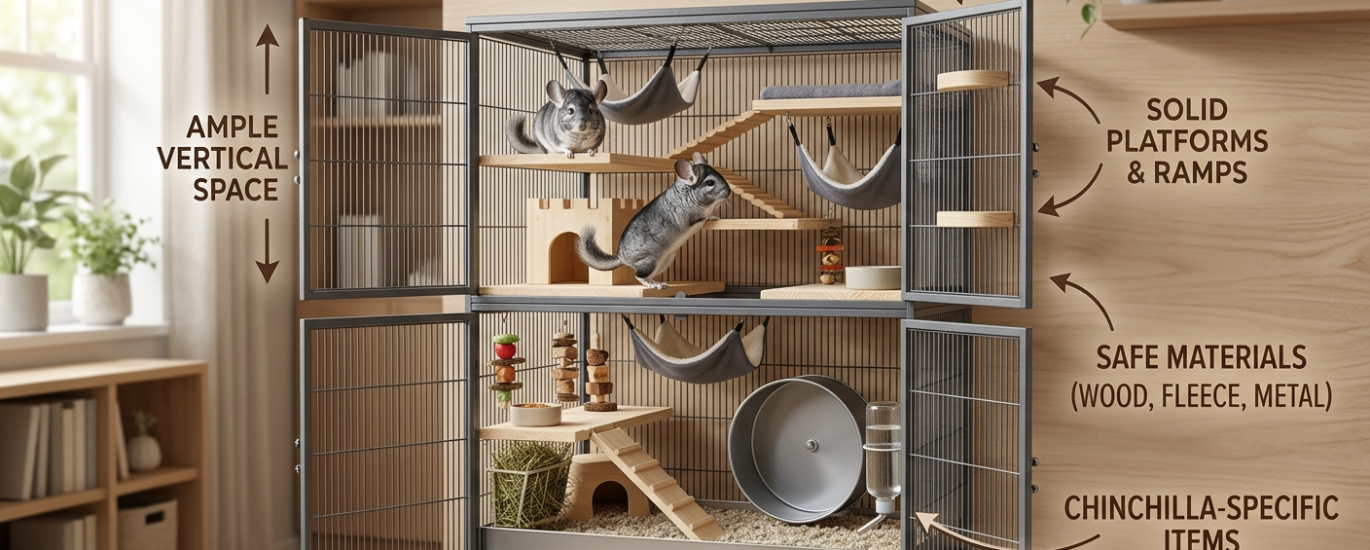
1. Sufficient size with multiple levels. Chinchillas need vertical space to jump and horizontal space to run. A multi-level cage with solid platforms at varied heights is essential. The minimum dimensions recommended by veterinary sources for a single adult chinchilla are 3 feet wide × 2 feet deep × 3 feet tall, though larger is always better.
2. Metal construction only. Chinchillas chew constantly and compulsively. Plastic parts — trays, platforms, tunnels — will be destroyed and, more importantly, ingested. Swallowed plastic can cause gastrointestinal obstruction, a life-threatening condition. The cage body and all internal fittings must be metal or untreated, chinchilla-safe hardwood.
3. Bar spacing no wider than 1 inch (2.5 cm). Larger gaps allow chinchillas to push their heads through or, in the case of young or small animals, escape entirely. Many chinchillas have been seriously injured — or lost legs to amputation — after a foot caught in oversized wire mesh. The floor wire, if present, should have gaps no larger than ½ inch × ½ inch.
4. No galvanized-before-weld wire. Galvanized wire used in some cages is welded before the galvanizing process is applied, which can leave lead deposits at the weld joints. Chinchillas that chew the bars — which they will — can ingest this lead. Always look for galvanized-after-weld (GAW) construction, or powder-coated steel. Do not use galvanized wire that contains zinc, which is also toxic.
5. No glass enclosures or solid-sided tanks. Chinchillas require substantial airflow. An aquarium or solid-sided terrarium creates a buildup of heat and ammonia from urine that can cause serious respiratory and neurological harm. The enclosure must have open wire sides to allow ventilation.
6. Secure, lockable doors. Chinchillas are escape artists of the highest order. If there is a way out, they will find it. Double-latching doors with secure closures — or padlocks for determined individuals — are strongly recommended. A loose chin in your home will chew electrical wires, ingest toxic materials, and may be injured or killed.
3. What Size Cage Does a Chinchilla Need? {#cage-size}
This is the question most new owners get wrong, primarily because cages sold in general pet shops are often far too small and poorly labeled for chinchillas.
Minimum recommended dimensions (single adult chinchilla):
According to VCA Animal Hospitals, one of the most widely cited veterinary authorities on exotic mammal care, the enclosure should be a minimum of 3 feet wide × 2 feet deep × 3 feet tall for one chinchilla, scaling up to 3 feet wide × 2 feet deep × 5 feet tall for a pair.
The Veterinary Center for Birds and Exotics sets the same 3′ × 2′ × 2′ minimum, while many specialist rescue organizations and breeders recommend going significantly larger. Forever Feisty Chinchilla Rescue — one of the most respected chinchilla rescues in the United States, operating since 2003 — recommends a minimum of 36″ H × 18″ D × 30″ W even for a single chinchilla.
Key sizing principles to know:
Chinchillas are not tree-climbing animals — they are rock-hoppers. This means floor space and wide levels matter more than raw height alone. A very tall cage that is narrow with only narrow perches is not as useful as a wider cage with broad platforms. If you have a tall cage, you must break the vertical space with wide, solid shelving every 18–24 inches to prevent a fatal fall. A good rule of thumb: no single fall should be longer than approximately 24 inches (four chinchilla body lengths).
Chinchillas can jump up to 6 feet in the air. If your space allows a cage of that height, your chinchilla will use every inch.
For chinchillas under 6 months, cage height should be limited to around 24 inches, as young animals lack the sure-footedness of adults and are at serious risk of injurious falls.
Two chinchillas need meaningfully more space than one. A pair in a space meant for a single will show increased territorial behavior and stress. See our chinchilla behavior guide for more on social dynamics and pairing.
4. The Best Chinchilla Cages in 2025 {#best-cages}
🥇 Best Overall: MidWest Homes Critter Nation Double Unit (Model 162)
The Critter Nation Double Unit is the cage most consistently recommended by chinchilla rescue organizations, experienced owners, and exotic veterinarians across North America and Europe. It measures 36″ L × 24″ W × 63″ H — well above minimum requirements — and is expandable with a third unit add-on.
What sets it apart: the full-width double doors that open across the entire front of the cage, making cleaning and interaction genuinely easy. Horizontal bar spacing of ½ inch is safe for chinchillas of all ages, including kits. The all-metal powder-coated construction prevents chewing damage and eliminates plastic ingestion risk when metal replacement pans are used in place of the included plastic trays (BASS Equipment metal pans are a popular upgrade).
The cage comes on lockable wheels for easy room-to-room movement. Horizontal bars allow you to clip shelves, ledges, hammocks, and toys at virtually any height.
The one caveat: the included plastic pans should be covered with fleece liners or replaced with metal alternatives to prevent your chinchilla from chewing through them.
Dimensions: 36″L × 24″W × 63″H | Bar spacing: ½ inch | Construction: Powder-coated steel
🥈 Runner-Up: MidWest Homes Ferret Nation Double Unit (Model 182)
The Ferret Nation is the Critter Nation’s heavier-gauge sibling. It is built from slightly thicker wire, making it arguably the more durable option long-term. The key difference: bar spacing is 1 inch (versus ½ inch on the Critter Nation), which means it is only suitable for adult chinchillas over 6 months of age. Younger, smaller, or very thin animals may push through 1-inch spacing.
The Ferret Nation’s vertical bar orientation makes attaching shelves slightly less flexible than the horizontal bars of the Critter Nation, but many experienced keepers prefer its sturdiness. Both models share the same dimensions and the same excellent door design.
Dimensions: 36″L × 25″W × 62.5″H | Bar spacing: 1 inch (adults only) | Construction: Powder-coated steel
🥉 Best Premium/USA-Made: Quality Cage Chinchilla Mansion
The Quality Cage Chinchilla Mansion is a chinchilla-specific cage handmade in the USA, designed from the ground up for chinchilla welfare rather than adapted from ferret or rat cage designs. It features a drop-pan design for simple cleaning, comes with wooden shelves (customizable in number and layout), and is available in several sizes — the Mansion model accommodates up to four adult chinchillas comfortably.
This is the cage of choice for many professional breeders and dedicated rescue organizations. It is more expensive than the MidWest options but represents a lifetime investment in a purpose-built enclosure.
Find it at: qualitycage.com
Budget Option: Martin’s Cages Chinchilla Skyscraper (Model R-695)
Recommended by Forever Feisty Chinchilla Rescue, Martin’s Cages produces a range of solid, GAW wire cages at a lower price point than the above options. They are customizable, made to order, and can be specified in either drop-in pan or pull-out tray configuration. They represent a solid, safe choice for budget-conscious owners who still want a properly constructed enclosure.
What to Avoid at Pet Shops
Most cages sold in general pet retailers as “chinchilla cages” are too small, use plastic components, or have unsafe bar/floor spacing. Several rescue organizations report receiving chinchillas with amputated legs caused by feet catching in oversized wire mesh in pet store cages. Never use:
- Rabbit cages
- Guinea pig cages
- Standard hamster cages
- Glass aquariums or solid-sided tanks
- Cages with plastic shelving, ramps, or tubes
- Any cage described as a “starter” or “starter home” for chinchillas
5. Cage Placement and Environment {#placement}
The best cage for a chinchilla is the right cage in the right place. Placement is as important as the enclosure itself.
Temperature is the most critical factor. Chinchillas are extremely vulnerable to heat. Their optimal temperature range is 55°F–68°F (13°C–20°C), and the environment should never exceed 75°F–80°F (24°C–27°C). Above this, heatstroke can occur rapidly and is often fatal. Humidity should remain below 50%. If your home gets warm in summer, a dedicated room with air conditioning — or a cool basement — is essential.
Drafts are equally dangerous. Steady airflow from an open window, a vent, or an air conditioner blowing directly on the cage can cause respiratory illness. Good ambient ventilation is needed, but direct drafts must be avoided.
Quiet location. Chinchillas are crepuscular — most active at dawn and dusk — and sleep during much of the day. Position the cage away from televisions, speakers, children’s playrooms, and busy corridors. Sudden loud noises will stress your chinchilla significantly and can trigger fear responses and fur-slip (defensive fur loss — see our grooming guide).
Off the floor. As prey animals, chinchillas feel more secure when elevated. Place the cage on a stand rather than directly on the floor. This also protects against cold from cold floors and makes it harder for dogs or cats to press against the cage.
Out of direct sunlight. A cage in a sunny window will overheat within hours even in mild weather.
For a full discussion of environmental needs, see our chinchilla housing guide.
6. Essential Cage Accessories and Setup {#accessories}
The cage itself is only the start. The following accessories are not optional extras — they are functional necessities for a healthy, mentally stimulated chinchilla.
Wooden shelves and ledges. These should be arranged to break the vertical space of the cage into reachable levels. Shelves must be wide enough for a chinchilla to sit comfortably and made from untreated, chinchilla-safe hardwood (kiln-dried pine, apple, or pear). Remove and replace them regularly as they become soaked with urine over time. For more on safe materials and chewing behavior, see our chinchilla health guide.
Exercise wheel. A chinchilla-specific wheel is essential for physical health and prevention of boredom. The wheel must be at least 15 inches (38 cm) in diameter so your chinchilla can run with a straight back. Smaller wheels force an unnatural arch that damages the spine over time. The running surface must be solid — never wire mesh or rungs, which can trap feet. The Chin Spin is the most widely recommended model by veterinary sources.
Nest/hide box. Chinchillas need a dark, enclosed space to retreat to and sleep in. A wooden nest box or appropriately sized wooden house provides this. This is non-negotiable for their psychological welfare.
Water bottle. A glass or metal-spout water bottle is strongly preferred over a bowl. Bowls become contaminated with dust, droppings, and bedding within hours. Water must be fresh daily. Never leave a chinchilla without water.
Food dish. A heavy ceramic or metal bowl that cannot be overturned. Chinchillas will otherwise tip plastic dishes constantly.
Dust bath house. A covered dust bath enclosure placed in the cage several times per week is essential for chinchilla grooming — their coat is maintained through volcanic dust rolling, not water bathing. A covered house reduces dust spread throughout your home. The bath should be offered 2–3 times per week for about 15–20 minutes per session.
Hay feeder. Unlimited timothy hay is the foundation of chinchilla nutrition. A wall-mounted hay rack (without sharp wire protrusions) or a hay bag keeps the hay clean and accessible. See our nutrition guide for hay types and feeding schedules.
Chew toys. Unpainted, untreated wood chews are essential for dental health — chinchilla teeth grow continuously throughout their lives and must be kept worn down. Applewood sticks, willow rings, and pumice blocks are all excellent options. See the chinchilla health guide for dental care detail.
Bedding. Paper-based bedding (such as Carefresh) or fleece cage liners are the safest options. Never use cedar or pine shavings — the aromatic oils cause respiratory damage. Avoid “expanding” bedding of any kind, which can cause fatal intestinal obstruction if ingested.
7. What to Avoid: Cage Dangers and Common Mistakes {#avoid}
The following items cause serious, preventable harm and should never be placed in or near a chinchilla cage.
Exercise balls (“death balls”). These plastic rolling balls are too small for a chinchilla’s spine, lack ventilation, and have been responsible for numerous injuries and deaths from overheating and spinal compression. They are a common pet store sale item and are universally condemned by chinchilla welfare experts.
Wire hay racks with sharp or wide gaps. Multiple rescue organizations have documented chinchillas catching eyelids, limbs, or entire heads in wire hay racks. Use smooth-edged hay storage only.
Plastic items of any kind inside the cage. All plastic will be chewed. All chewed plastic becomes a gastrointestinal hazard. Replace the standard plastic pans that come with MidWest cages with metal alternatives.
Fabric other than fleece. Other fabrics fray when chewed, creating threads that can cause intestinal obstruction. Fleece does not fray — but even fleece should be removed and replaced when it becomes chewed through.
Cedar or pine bedding. The phenols in aromatic wood shavings cause chronic respiratory inflammation.
Pet store wheels under 15 inches. Typically 11–12 inches in diameter, these cause spinal arching and back injury with prolonged use.
Positioning the cage near other pets. The stress of a dog or cat repeatedly approaching the cage can cause chronic anxiety and health deterioration even without direct contact. Keep dogs and cats out of the room the chinchilla lives in, at minimum while the chinchilla is active.
8. Official Chinchilla Cage Guidelines by Country {#by-country}
Cage standards vary considerably across jurisdictions. Below are the current guidelines and legal frameworks governing chinchilla housing in ten countries. Where specific chinchilla cage dimensions are not legislated for pet ownership, we note the applicable animal welfare legislation and the standards recommended by the leading national welfare organization.
🇺🇸 United States
Legal framework: There is no single federal law specifying minimum cage dimensions for privately owned pet chinchillas in the USA. The Animal Welfare Act (AWA), enforced by the USDA APHIS, applies primarily to commercial dealers and exhibitors. Pet owners are governed by state-level animal cruelty statutes.
Recommended standards: The VCA Animal Hospitals recommend a minimum of 3’W × 2’D × 3’H for one chinchilla and 3’W × 2’D × 5’H for a pair. The Global Chinchilla Alliance and specialist rescues including Forever Feisty Chinchilla Rescue recommend a minimum of 30″W × 18″D × 36″H, with larger always preferred.
Key requirement: The common expert understanding is that chinchillas do better in wider cages than taller ones due to their rock-hopping nature. Minimum suggested: 31″L × 20.5″W × 40″H, with 1-inch bar spacing maximum.
Official reference: USDA APHIS Animal Welfare
🇬🇧 United Kingdom
Legal framework: Chinchillas are protected under the Animal Welfare Act 2006, which places a positive “duty of care” on all pet owners in England and Wales to meet five basic welfare needs: suitable environment, appropriate diet, ability to exhibit normal behavior, appropriate companionship, and protection from pain and disease. The equivalent legislation in Scotland is the Animal Health and Welfare (Scotland) Act 2006.
Recommended standards: The RSPCA Suffolk Central adoption policy (one of the most specific published UK guidelines) requires chinchilla enclosures to be a minimum of 6ft (L) × 2ft (W) × 5ft (H) for adoption approval, increasing with the number of animals housed. The Blue Cross recommends multi-level cages, kept in cool conditions away from drafts and direct sunlight.
Key requirement: Bar spacing no wider than 1 inch (2.5 cm). The Animal Welfare Act 2006 requires that animals can exhibit normal behavior — which, for chinchillas, includes jumping, climbing, and running. A cage preventing these behaviors constitutes inadequate housing under the Act.
Official references: Animal Welfare Act 2006 – legislation.gov.uk | RSPCA – rspca.org.uk
🇨🇦 Canada
Legal framework: Animal welfare in Canada is primarily regulated at the provincial level. Most provinces have enacted Prevention of Cruelty to Animals (PCA) Acts or equivalent legislation. Ontario’s Provincial Animal Welfare Services (PAWS) Act 2019 is among the most comprehensive, explicitly requiring that an animal’s physical and psychological needs be met, including the provision of adequate space to move normally.
Recommended standards: The Canadian Chinchilla Rescue (CCR) — the country’s primary specialist rescue — requires cage photos as part of the adoption application process and will not approve enclosures that do not allow normal movement and behavior. The minimum standard widely applied across Canadian rescues aligns with VCA guidelines: 3′ × 2′ × 3′ minimum for one chinchilla.
Key requirement: Canadian rescues specifically prohibit “free-range” housing (where chinchillas are not caged). The PAWS Act empowers inspectors to seize animals kept in conditions causing distress.
Official reference: PAWS Act – ontario.ca | Canadian Chinchilla Rescue
🇩🇪 Germany
Legal framework: Germany’s Tierschutzgesetz (TierSchG — Animal Protection Act) provides a robust national framework and is one of the strongest animal welfare laws in Europe. Under §2 TierSchG, any person keeping an animal must provide appropriate accommodation, food, and care based on the behavioral needs of the species. The Tierschutz-Heimtierverordnung (Animal Welfare Companion Animal Ordinance) provides supplementary requirements for pet keeping.
Specifically relevant: Germany’s TierErzHaVerbG (law on certain animal product trade and keeping bans) references chinchilla housing in the context of former fur farming regulations and specifies minimum cage dimensions that remain instructive for welfare standards. German law was amended to require increased minimum cage sizes for chinchillas and supply of environmental enrichment.
Recommended standards: German animal welfare organizations including Deutsches Tierschutzbüro recommend minimum enclosure dimensions for chinchillas of 100cm × 50cm × 100cm (LxDxH) as an absolute floor, with the expert standard (from Chinchilla-Scientia.com) recommending 3 cubic meters of total volume for 2–3 animals: ideally 2m wide × 0.8m deep × 1m tall as a minimum configuration.
Key requirement: Under TierSchG §2, housing must allow the animal to exhibit species-appropriate behavior. Failure to provide adequate housing is a criminal offense carrying fines up to €25,000 and potential prosecution.
Official reference: Tierschutzgesetz – bundesrecht.de (bundesjustizamt.de) | Deutsches Tierschutzbüro
🇵🇱 Poland
Legal framework: Poland’s Ustawa o ochronie zwierząt (Animal Protection Act, 1997, as amended) prohibits the keeping of animals in conditions that do not meet their physiological and behavioral needs. The law was strengthened by amendments in 2020 which increased penalties for animal welfare violations significantly.
Recommended standards: No Polish national body publishes specific minimum dimensions for chinchilla cages, but the general welfare standard under the Act requires that chinchillas be able to display natural movement behaviors. The Towarzystwo Opieki nad Zwierzętami Polskimi (TOTP) — Poland’s main animal protection society — applies the widely accepted European minimum of 100cm × 60cm × 100cm for a single adult chinchilla as a practical standard.
Key requirement: Keeping animals in conditions causing unnecessary suffering is a criminal offense under Polish law, with fines up to 5,000 PLN and possible imprisonment for serious violations.
Official reference: Ustawa o ochronie zwierząt – isap.sejm.gov.pl | TOTP – toz.pl
🇷🇺 Russia
Legal framework: Russia enacted the Federal Law No. 498-FZ “On Responsible Treatment of Animals” in 2018, which came into full force progressively through 2020. The law prohibits keeping animals in conditions that do not meet their biological and behavioral needs, and establishes welfare obligations for all pet owners including owners of exotic pets.
Recommended standards: Russian national veterinary guidance for chinchilla housing recommends a minimum cage size of 100cm × 60cm × 80cm (LxDxH) for one adult chinchilla, with the largest available cage strongly preferred. The law specifically prohibits keeping animals in ways that cause suffering from deprivation of movement.
Key requirement: Under Federal Law No. 498-FZ, owners must provide animals with conditions that correspond to their biological needs. Violations can result in fines and confiscation of animals.
Official reference: Federal Law No. 498-FZ – consultant.ru
🇯🇵 Japan
Legal framework: Japan’s Act on Welfare and Management of Animals (動物の愛護及び管理に関する法律, revised 2020) governs all aspects of pet keeping. The 2020 revision strengthened protections significantly, requiring pet owners to provide animals with environments that do not cause unnecessary suffering and that allow expression of natural behaviors. The Ministry of the Environment (環境省) publishes care guidelines for various species including exotic rodents.
Recommended standards: Japan’s Ministry of the Environment guidance on exotic small mammal keeping recommends that chinchillas be housed in metal-wire enclosures allowing jumping and multi-level movement, with a minimum floor area of approximately 60cm × 45cm for a single animal, and emphasizes that enclosures must allow the expression of natural acrobatic behaviors.
Key requirement: Commercial sellers of exotic pets must provide written care information at the point of sale under the 2020 amended Act. Violations of care standards are subject to administrative guidance and fines.
Official reference: Act on Welfare and Management of Animals – env.go.jp
🇫🇷 France
Legal framework: France’s animal welfare framework is grounded in the Code Rural et de la Pêche Maritime (Rural and Maritime Fishing Code), Articles L214-1 et seq., which recognize animals as sentient beings and impose care obligations on owners. The Loi du 30 novembre 2021 portant lutte contre la maltraitance animale (Law of 30 November 2021 on combating animal cruelty) substantially strengthened penalties and introduced new requirements including a “Certificate of Commitment and Knowledge” now required for first-time acquisition of a domestic animal.
Recommended standards: The SPA (Société Protectrice des Animaux) — France’s primary animal welfare organization — recommends that chinchilla enclosures provide a minimum of 1 m² of floor space for one or two animals, with multi-level architecture, at temperatures between 15°C and 20°C.
Key requirement: Under the 2021 law, pet store purchasers of domestic animals must sign a formal acknowledgment of care requirements. The law also prohibits selling chinchillas (or any domestic animal) to individuals under 18 years of age without parental consent.
Official reference: Code Rural – legifrance.gouv.fr | SPA – spa.asso.fr
🇳🇱 Netherlands
Legal framework: The Netherlands operates under the Wet dieren (Animals Act 2011) and supplementary Besluit houders van dieren (Decree on Animal Keepers), which set out specific requirements for the keeping of various companion animal species. The Dutch welfare framework is among the most detailed in Europe. Notably, the Netherlands banned chinchilla fur farming in 1997 (effective 2008), partly because adequate welfare standards could not be achieved — a legislative acknowledgment of the species’ complex housing needs.
Recommended standards: The Dierenbescherming (Animal Protection Netherlands) recommends multi-level enclosures with a minimum floor area of 1.0 m² for chinchillas, with height of at least 1.5 m, maintained at temperatures below 20°C. The Dierenbescherming specifically notes that bar spacing must not exceed 2.5 cm (1 inch).
Key requirement: The Animals Act requires that animals be housed in ways compatible with their ethological (behavioral) needs. The Netherlands Food and Consumer Product Safety Authority (NVWA) enforces animal welfare legislation and can impose fines for inadequate housing.
Official reference: Wet dieren – wetten.overheid.nl | Dierenbescherming – dierenbescherming.nl | NVWA – nvwa.nl
🇮🇹 Italy
Legal framework: Italy’s animal welfare legislation is governed by the Legge 20 luglio 2004, n. 189 (Law 189/2004 on Companion Animals and Prevention of Animal Cruelty), which prohibits keeping animals in conditions incompatible with their ethological nature. Italy also implements the European Convention for the Protection of Pet Animals (Council of Europe, ETS No. 125), which Italy ratified and which sets standards for the housing and care of companion animals.
Recommended standards: The ENPA (Ente Nazionale Protezione Animali) and LAV (Lega Anti Vivisezione) recommend chinchilla enclosures of at least 100cm × 60cm × 100cm (LxDxH) for a single animal, maintained at temperatures between 15°C and 20°C. The European Convention specifies that companion animals must be provided with space, freedom of movement, and environmental conditions appropriate for their species.
Key requirement: Under Italian law, abandonment of animals is a criminal offense punishable by imprisonment of up to 1 year. Keeping animals in conditions causing unnecessary suffering is similarly prosecuted under Law 189/2004.
Official reference: Legge 189/2004 – normattiva.it | ENPA – enpa.it | Council of Europe ETS 125
9. Frequently Asked Questions {#faq}
What is the absolute minimum cage size for a chinchilla? The absolute minimum recommended by veterinary sources (VCA Animal Hospitals) for a single adult chinchilla is 3 feet wide × 2 feet deep × 3 feet tall. This should be treated as a floor, not a target. A larger cage will always benefit your chinchilla’s physical and mental health.
Can two chinchillas share one cage? Yes, and in fact chinchillas are social animals that often do better in pairs than alone. However, two chinchillas need proportionally more space — VCA recommends at least 3′ × 2′ × 5′ for a pair. Same-sex pairs (particularly two males who are brothers or father and son) generally coexist most peacefully. For guidance on introductions, see our chinchilla behavior guide.
Is a Ferret Nation cage safe for chinchillas? Yes, for adult chinchillas over 6 months. The 1-inch bar spacing is within safe limits for adults. For young, small, or kit chinchillas, the Critter Nation (½-inch spacing) is the safer choice.
How often should a chinchilla cage be cleaned? Spot-clean daily (remove visible droppings and soiled bedding). Do a full clean — remove all bedding, disinfect with pet-safe cleaner, rinse thoroughly, and replace bedding — at least weekly. Food bowls and water bottles should be cleaned with soap and water every day. For health implications of poor cage hygiene, see our chinchilla health guide.
Can I keep a chinchilla in a wooden cage? Wood is generally not suitable as a cage structure because chinchillas will chew through it. Wood can be used for shelving, ledges, and nest boxes inside a metal cage, provided it is untreated, kiln-dried, and from a known chinchilla-safe species. If a wood enclosure is used for brief periods (such as a play area), ensure it has no painted, varnished, or treated surfaces.
My chinchilla keeps trying to escape — what should I do? This is normal exploratory behavior and does not mean the cage is wrong. Ensure door latches are secure, add padlocks if necessary, and make sure the enclosure is large enough and sufficiently enriched to hold your chinchilla’s interest. See our chinchilla behavior guide for more on environmental enrichment. Regular supervised out-of-cage playtime in a chinchilla-proofed room also significantly reduces escape attempts.
Do I need to let my chinchilla out of the cage? Yes. Even the largest cage cannot substitute for daily out-of-cage exercise time. Allow your chinchilla at least one hour per day in a fully chinchilla-proofed room — all cables covered, no toxins accessible, no other pets present. Chinchillas love to run, jump, and explore, and this time is vital for physical health and bonding.
Final Thoughts: Invest in the Right Cage
The best cage for a chinchilla is not the cheapest one that physically contains them. It is the largest, safest, most enriching environment you can provide — one that allows them to jump, climb, hide, run, and rest as their biology demands.
The MidWest Critter Nation Double Unit remains the top recommendation for most owners in 2025: widely available, rigorously tested by the chinchilla community, safe for all ages, expandable, and easy to maintain. For those seeking a premium USA-made purpose-built option, the Quality Cage Chinchilla Mansion is unmatched.
Whatever cage you choose, ensure it meets or exceeds the national guidelines for your country, incorporate all the essential accessories, place it in the right environment, and commit to the daily care routines that keep your chinchilla healthy for the next two decades.
For everything else your chinchilla needs — from diet to dental care to socialization — explore our complete guides: housing, health, nutrition, behavior, grooming, and adoption.
Last updated: April 2026 | This article is for informational purposes. Always consult a qualified exotic animal veterinarian for species-specific health and care advice.